
A master key works because each lock in the system holds one extra tiny pin. That pin gives the lock two correct key heights instead of one. Your key opens your door. The master key opens every door on the plan.
Straight Answer
- The key is normal. The locks are built to take two or more keys.
- Each door gets its own key. A master opens a set. A grand master opens all.
- Every extra key a lock accepts makes that lock a little easier to beat.
- A "Do Not Duplicate" stamp carries no legal weight in the U.S.
- A lost master key means the whole system gets repinned.
- Most shops with three or more doors and staff are the right fit.
Business owners in Auburn and Opelika ask us the same thing. Can one key open the front, the office and the stock room, while staff only open what they need? Yes. That is a master key system. It also has costs that a sales pitch skips.
One Lock, Two Right Answers
Most door locks are pin tumbler locks. Inside the cylinder sit five or six stacks of small pins on springs. Your key lifts each stack to one exact height. When every stack lines up with the edge of the turning plug, the lock opens. Locksmiths call that edge the shear line.
A master keyed lock adds a thin extra pin to some stacks. Wikipedia's master keying entry describes these locks as having two shear points at each pin position. One height fits your change key. The other fits the master.
That is the whole trick. As Wikipedia puts it, there is usually nothing different about the master key itself. All the work is in how the locks are pinned.
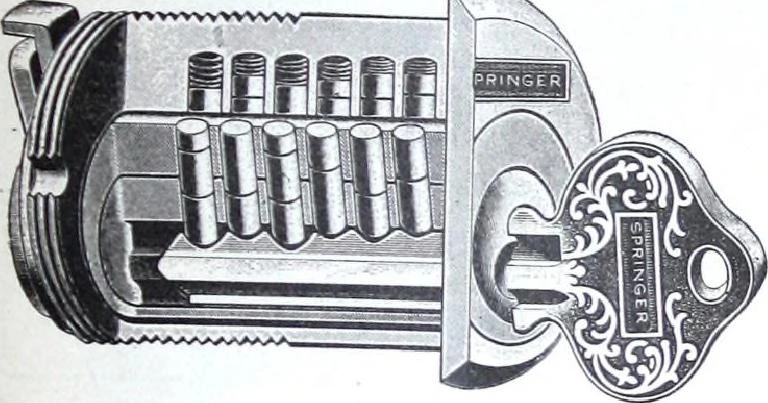
Most systems today use one plug and extra pins. A few designs use two cylinders in one lock, one for each key. Wikipedia calls that design more secure and more costly.
The Key Ladder, Top to Bottom
A master system is a family tree of keys. Small shops use two levels. A bigger building can use three or four. The names are standard across the trade.
| Key | What It Opens | Who Usually Holds It |
|---|---|---|
| Change key | One door only | Each staff member, or each tenant |
| Master key | A group of doors, like one floor or one wing | A manager or a lead |
| Grand master key | Every group in the building | The owner |
| Great grand master | Several buildings on one plan | A property company or a campus |
A two door shop does not need a ladder. A strip center with six units might use two levels. Each tenant opens their own suite. The owner opens all six.
Every Extra Key Costs Some Security
The extra pins have a price. Wikipedia says master keyed systems generally reduce overall security. The reason is simple math.
A stack with two shear points accepts two heights. Six stacks with two heights each accept 2 x 2 x 2 x 2 x 2 x 2 keys. That is up to 64 keys that can turn one lock, per the same entry. A lock built for one key now turns for many.
Blaze's paper calls this cross keying, when keys open more locks than intended. A good system is planned on paper first so those strays are not handed out. A system pieced together over years often has them.
One Staff Key Can Lead to the Master
This is the risk owners rarely hear about. In 2003, Matt Blaze of AT&T Labs published a paper in IEEE Security and Privacy on master keyed locks. He showed that a person with one change key and its lock can work out the master key.
- No special skill or tools were needed, per the paper.
- The person needs only a few key blanks and a metal file.
- Nothing has to happen at the door that looks odd. The person just tries test keys in their own lock.
- Blaze put the cost of the blanks at under about two U.S. dollars.
The full paper is free at mattblaze.org. Blaze also found that master keyed locks tend to be easier to pick. His point was not to stop using master systems. It was that the master key is only as safe as every lock it opens.
So the people you hand a change key to matter. That includes a seasonal hire and a contractor who keeps a key for a month.
"Do Not Duplicate" Will Not Stop a Copy
Many owners stamp keys "Do Not Duplicate" and stop there. Wikipedia's key duplication entry says that in the U.S. this stamp has no legal weight. A clerk can choose to refuse. Nothing makes them.
Alabama law makes copying easy, too. House Bill 338, passed in 2025, says a business that only duplicates an existing key is not a locksmith. It needs no locksmith license to copy it. So any kiosk or counter in Lee County can copy a standard key.
What does slow copies down is a restricted keyway. Wikipedia notes that restricted keys are often protected by patent. Other makers cannot legally sell blanks for them. Ask your locksmith about it before the system goes in, not after.
When an Employee Leaves With a Key
What you do depends on which key walked out the door.
| Key That Left | What to Rekey |
|---|---|
| A change key for one door | That door. It is a small job. |
| A master key for one group | Every lock in that group |
| The grand master | Every lock in the building |
| An unknown key | Treat it as the highest key it could be |
Rekeying means new pins, not new locks. Wikipedia's rekeying entry says locks are usually rekeyed to build master systems, to make locks share a key, or to cut off keys that are out of your control. The hardware stays on the door.
This is why masters should be few. If only two people hold one, a quit or a firing rarely touches the whole building.
Does Your Business Need One?
Not every shop does. Use this as a quick guide.
- One door, one owner. Skip it. Rekey when a key goes missing.
- A few doors, a small staff. Key the outside doors alike. Give the office and the cash room their own keys.
- Three or more rooms that staff should not all enter. A two level master system fits.
- Rentals or a small multi tenant building. Each tenant opens their own door. The owner opens all of them.
- High turnover. Plan for frequent rekeys, or ask about restricted keys first.
Before a locksmith pins anything, write a key log. List each door, each key and who holds it. Number every key. Keep the list somewhere other than the office it protects.
What to Ask Next
What is the meaning of master key?
A master key is one key that opens a set of locks. Each lock in that set also has its own key that opens only that lock.
Does a master key open all locks?
No. It only opens locks that were pinned for that system. It will not open your neighbor's door or a lock from another plan.
What is the difference between a master key and a skeleton key?
A skeleton key is an old style key for warded locks. It is filed down so it slips past the wards inside, per Wikipedia. A master key works on pin tumbler locks that were built to accept it.
Can my existing locks be put on a master system?
Often, yes. A master system is built by rekeying, so the cylinders can stay on the doors. A locksmith can tell you if any of yours need new cylinders first.
Can I buy a master key that opens any lock?
No. A master key is cut for one system. There is no store key that opens every lock.
Is there a key that cannot be copied?
No key is copy proof. Patented restricted keys are the hardest to copy, because other makers cannot legally sell the blanks.
Setting Up Keys for Your Business
We set up master systems for rentals, shops and small commercial buildings across east Alabama. When an employee leaves with a key, we rekey the affected doors the same day. Call (334) 655-1300 and get an upfront price before a technician rolls. Our commercial locksmith page and rekey service page have more. We cover Auburn, Opelika and 15 more towns. We are open 6am to 9pm daily, with 24-hour emergency service.
Close Cousins
- Rekey Every Outside Door When You Buy a House in Auburn
- The Door Locks Police Recommend Start With a 3 Inch Screw
- Alabama Landlords Cannot Change the Locks to Force You Out